How to Safely Buy and Sell Gaming Accounts on Online Marketplaces While Ensuring Account Security
A maxed-out character with rare gear, a Radiant rank in a competitive shooter, or a Fortnite account loaded with legacy skins - these aren't just digital trophies. They represent hundreds of hours and, in many cases, hundreds of dollars. The market that has grown around these assets is substantial, active, and largely unregulated, which makes knowing how to operate within it a genuinely useful skill.
Account trading has become a routine part of gaming culture. Players sell accounts when they quit a game, consolidate profiles, or need to recover money spent on in-game purchases. Buyers enter the market to skip a grueling grind, access rare content no longer obtainable through normal play, or jump straight into competitive tiers. If you want to buy account access for a specific title, platforms like buy account have emerged to provide structured, category-organized listings that make this process more manageable and transparent than hunting through unmoderated forums.
But convenience doesn't automatically mean safety. The account trading space has its share of misrepresented listings, recovery scams, and poorly built platforms with no real buyer protection. Whether you're a first-time buyer trying to make a smart gaming account purchase or a seller looking to exit a game without losing money in the process, understanding how this market works - and where it can go wrong - is what separates a clean transaction from a costly one. This guide covers everything you need to know.
Understanding the Gaming Account Trading Market
Account trading refers to the buying and selling of established gaming profiles, complete with their progress, items, currency, and ranking history. The appeal is straightforward: a new player can skip months of grinding, and a departing player can recover real value from their investment. Across titles like World of Warcraft, League of Legends, Valorant, FIFA's Ultimate Team mode, and Fortnite, demand for established accounts remains consistent because the effort required to build them from scratch is significant.
The market itself operates across several types of platforms. Peer-to-peer marketplaces allow sellers to list accounts independently, with varying levels of platform oversight. Specialized gaming account platforms are purpose-built for this kind of trading and typically offer game-specific filters, seller verification, and structured dispute resolution. At the lower end, forum threads and social media groups still facilitate trades with almost no safeguards at all.
Understanding what drives both sides of this market helps you make better decisions as a participant. Sellers are usually motivated by one of a few situations: they've quit the game entirely, they're consolidating multiple accounts, they need to recover funds spent on in-game content, or they've simply moved on to another title. Buyers are typically motivated by the desire to skip repetitive early-game progression, access rare cosmetic items that are no longer available through regular play, or enter competitive play at a higher starting point.
There is one important structural reality every participant should understand before going further: account trading almost universally violates the Terms of Service of the game publisher. This doesn't make it illegal under civil law in most jurisdictions, but it does mean that if the publisher detects a transfer, the account can be banned without recourse. This risk is real, variable by game, and should factor into every transaction decision.
- MMORPGs: traded for character level, gear quality, rare mounts, and in-game currency reserves
- Competitive shooters: traded primarily for rank, match history, and cosmetic collections
- Sports simulations: traded for squad value, coin reserves, and seasonal achievements
- Battle royale titles: traded heavily for legacy cosmetics no longer available in the store
- Forum and social media trades: highest risk, lowest accountability, no dispute resolution
- Specialized platforms: purpose-built infrastructure, seller verification, category-specific tools
How to Evaluate a Gaming Account Before Buying or Selling
Accurate valuation is where most avoidable mistakes happen. Buyers overpay for accounts that don't deliver on their descriptions. Sellers underprice accounts because they don't fully understand what they're holding. Both outcomes are preventable with the right approach.
Key Factors That Determine Account Value
Account value isn't universal - it's deeply tied to the game in question. In competitive titles, rank and match statistics dominate the valuation. In MMORPGs, gear quality, character level, rare item ownership, and profession progress carry more weight. In cosmetic-driven games like Fortnite, an account's skin collection - especially items from limited-time events or early seasons - can matter far more than any gameplay statistic.
Account age is a consistent value signal across most genres. Older accounts often contain content that's no longer obtainable: seasonal rewards, anniversary items, pre-patch unlocks, and early-access bonuses. A clean ban history is another baseline expectation. Any account with prior suspensions or active warnings carries elevated risk of future enforcement action, and that risk should be priced in accordingly.
| Value Factor | Why It Matters | Relevant Example |
|---|---|---|
| Rank or competitive tier | Reflects time investment and demonstrated skill | Diamond rank in a competitive shooter versus a new unranked account |
| Rare items or cosmetics | Limited availability creates lasting desirability | Legacy seasonal skins no longer available in-store |
| In-game currency reserves | Provides immediate usable value within the game | Large gold or coin stockpiles in MMORPGs or sports titles |
| Account age | Older accounts often contain unobtainable legacy content | Pre-expansion unlocks, anniversary rewards |
| Platform binding | Affects how easily access can be transferred | Standalone accounts versus those tightly linked to a launcher |
| Ban or suspension history | Past violations increase future enforcement risk | Accounts with logged warnings or prior temporary bans |
How to Verify Account Details as a Buyer
Listings can say anything. Verification is how you confirm that what's described actually exists. For any purchase above a nominal amount, require evidence before payment clears. Reputable sellers on well-run platforms are accustomed to providing this, and reluctance to share proof is itself a warning sign.
Third-party tracking tools exist for many major titles and allow buyers to independently verify rank history, match statistics, and achievement records without needing account access in advance. For League of Legends, op.gg provides detailed match and rank history. Similar tools exist for other competitive titles. Use them.
- Request dated screenshots of inventory, rank screen, and achievement lists
- Ask for a video walkthrough demonstrating account contents in real time
- Use third-party stat-tracking tools to independently verify rank and match history
- Confirm whether the original email address is included in the transfer
- Ask directly whether the account has any prior bans, warnings, or active flags
- Verify whether two-factor authentication is currently active and whether it will be disabled before handover
Setting a Fair Asking Price as a Seller
Research is the only reliable foundation for pricing. Browse active listings on the same platform for comparable accounts and look at completed sales where the platform makes that data visible. Price relative to what has actually sold, not just what other sellers are asking - asking prices and transaction prices often differ.
Transparency about your account's history, including any past violations or current restrictions, builds credibility and reduces the chance of post-sale disputes. Buyers who feel misled after a transaction are far more likely to escalate through dispute resolution channels, and even if the seller prevails, the process costs time and damages reputation on the platform.
Choosing the Right Online Account Marketplace
The platform you use shapes nearly every aspect of the experience: how much risk you carry, what recourse you have if something goes wrong, how quickly disputes are resolved, and whether the seller you're dealing with has any accountability at all. Choosing a platform casually is one of the most common mistakes new participants make.
What to Look for in a Secure Marketplace
The single most important feature a platform can offer is an escrow system - a mechanism where the platform holds the buyer's payment until the buyer confirms that access has been received and matches the listing description. Without escrow, the buyer sends money and then hopes for the best. With escrow, the seller only receives payment after the transaction is verified. This one feature eliminates the majority of straightforward fraud scenarios.
Beyond escrow, look for platforms that require sellers to verify their identity or email before listing, maintain visible transaction histories and buyer feedback for each seller profile, and provide a functioning dispute resolution process with a defined timeline. Customer support responsiveness matters more than it might seem - when something goes wrong, speed of resolution is directly tied to how quickly support can be reached.
- Escrow or platform-held payment until buyer confirms receipt
- Verified seller profiles with visible transaction history and ratings
- Clear, written refund and dispute resolution policy
- SSL-secured data transmission across the platform
- Identity or email verification required to list accounts
- Responsive customer support with defined response windows
- Privacy policy covering how payment and personal data are handled
Red Flags That Signal an Unsafe Platform
Some platforms attract problematic activity precisely because enforcement is weak. Recognizing the signs of an unsafe environment before you engage is far less costly than learning from a failed transaction.
Price is often the most visible red flag. Accounts listed dramatically below comparable market rates should raise an immediate question: why? In most cases, the answer involves either a misrepresented account, one with hidden issues like ban risk or incomplete transfer credentials, or an outright scam where access is never delivered. Deeply discounted prices are not deals - they're signals.
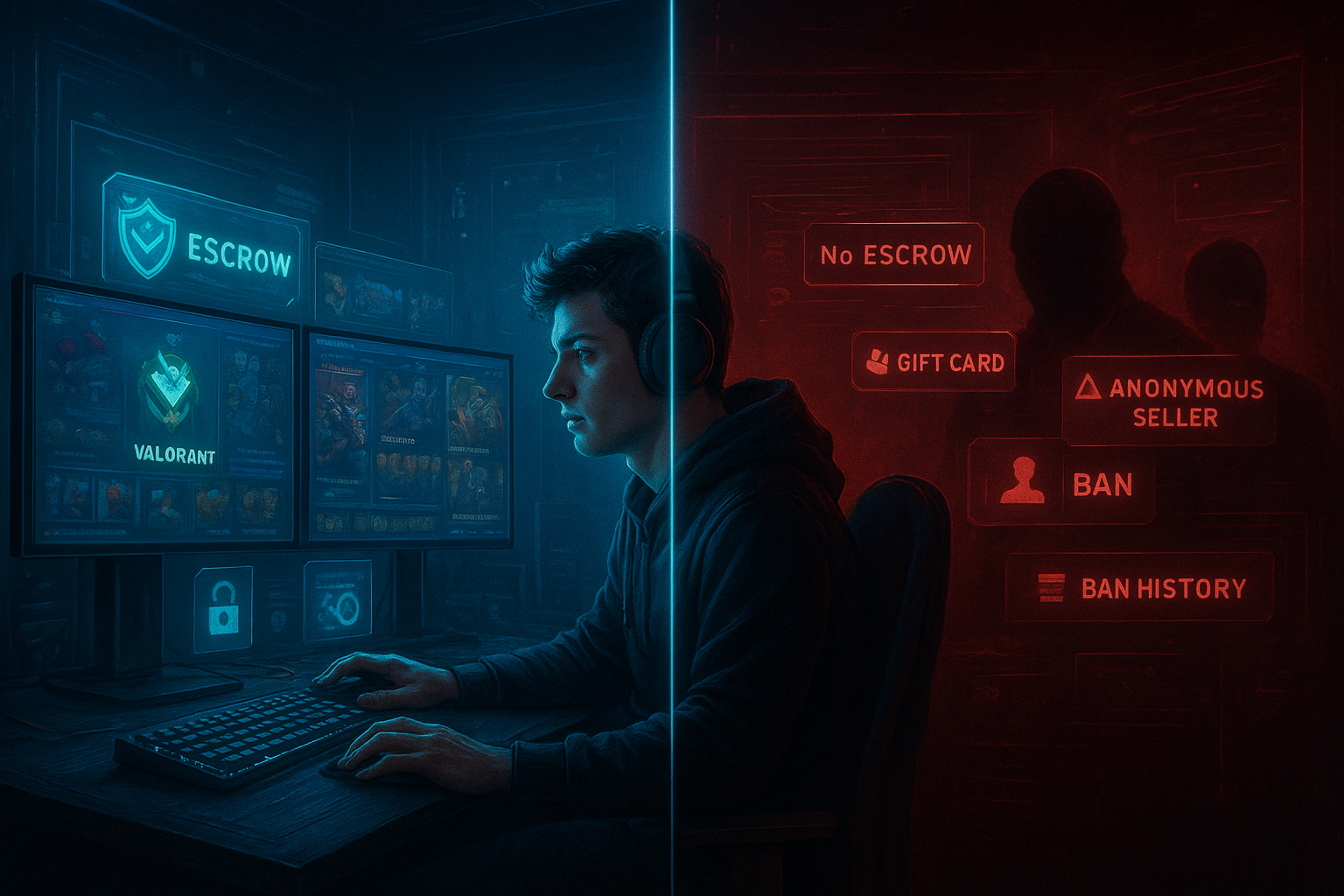
- No escrow or third-party payment holding of any kind
- Anonymous sellers with zero transaction history or reviews
- Prices significantly below comparable listings on other platforms
- No stated dispute resolution process or refund policy
- Requests for payment via gift cards, wire transfer, or unprotected cryptocurrency
- Poorly maintained platform with broken functionality, inactive moderators, or outdated listings
- No seller verification requirement before listing
Specialized Gaming Platforms vs. General Marketplaces
General-purpose marketplaces have handled gaming account listings for years, but they were not built for this purpose. They lack game-specific filters, have no infrastructure for verifying account contents, and their dispute resolution teams are unlikely to understand the nuances of what's being sold. A buyer trying to dispute a misrepresented rank or a missing rare item faces an uphill process on a platform that doesn't recognize those as meaningful categories.
Purpose-built gaming platforms solve these structural problems. They organize listings by game and account type, offer verification tools that make sense for the content being sold, and staff dispute resolution with people who understand the product. The tradeoff is typically a narrower user base, but for the security and clarity they provide, the specialization is worth it for most participants.
| Feature | General Marketplace | Specialized Gaming Platform |
|---|---|---|
| Game-specific category filters | Rarely available | Standard feature |
| Account content verification tools | Not available | Often built in or supported |
| Seller rating context | Generic buyer-seller feedback | Gaming-specific transaction context |
| Dispute resolution expertise | General, often slow | Category-aware, typically faster |
| Escrow protection | Sometimes available | Usually standard |
Step-by-Step Guide to Making a Safe Gaming Account Purchase
A structured approach to buying eliminates most of the risk that comes from rushing. Each step in the process below closes a specific vulnerability. Skipping even one of them - particularly around payment protection or post-purchase security - is where most buyer problems originate.
- Start on a reputable platform. Choose an online account marketplace with verified sellers, visible transaction histories, and a functioning buyer protection policy. Don't begin your search on unmoderated forums or social media groups.
- Filter and compare listings systematically. Compare accounts by rank, item inventory, account age, seller rating, and price relative to comparable listings. Don't stop at the first listing that looks appealing.
- Request verification proof before committing. Ask the seller for screenshots, a video walkthrough, or a live screen-share session demonstrating the account contents. Use third-party stat tools to cross-check rank and history independently.
- Review the seller's platform reputation. Check their transaction history, the volume of completed sales, and the content of buyer feedback. A seller with dozens of verified positive transactions represents meaningfully lower risk than one with no history.
- Pay only through the platform's protected payment system. Use escrow where available. Never send payment directly to a seller's personal account before receiving verified access.
- Log in and verify account contents before releasing payment. Confirm that everything described in the listing is present. If the platform uses escrow, do not confirm the transaction until this check is complete.
- Change all account credentials immediately. Update the password, associated email address, and any security questions as the first action after gaining access.
- Enable all available account security features. Activate two-factor authentication, review linked devices, and remove any payment methods left by the previous owner before doing anything else in the account.
How to Safely Sell an Account and Protect Yourself
Selling carries a different set of risks than buying, and they're less intuitive for first-time sellers. The most serious exposure isn't fraud during the sale - it's chargeback fraud after it, or account recovery attempts once the new owner has taken over. Preparation and documentation are the core defenses.
Preparing Your Account for Sale
Before you list anything, document what you're selling in as much detail as possible. Comprehensive screenshots of your inventory, rank screens, achievement lists, and any notable rare items serve two purposes: they attract serious buyers, and they provide evidence if a dispute arises after the sale. A short walkthrough video is worth more than a folder of screenshots in most dispute scenarios because it's harder to credibly claim misrepresentation against video evidence.
- Capture comprehensive screenshots of inventory, rank, and achievement screens
- Record a video walkthrough demonstrating account contents in real time
- Remove personal payment methods and any private information from linked profiles
- Research comparable sold listings to set a realistic, defensible asking price
- Disclose any prior bans, warnings, or account restrictions honestly in the listing
Transferring Account Access Securely
The moment of credential transfer carries the most concentrated risk in the entire selling process. Use the platform's escrow system to confirm that payment is secured and held before you hand over any login details. Transfer everything agreed upon - including the original linked email if that's part of the deal - in a single, documented exchange. Partial transfers that leave the seller retaining any recovery pathway are the most common setup for post-sale account recovery disputes.
Document the transfer itself. Many platforms generate a transaction record automatically. If yours doesn't, keep your own record of what was transferred, when, and to whom. That documentation can be decisive if a dispute is filed later.
Protecting Yourself After the Sale
Account recovery fraud - where the original owner uses retained email access or a support ticket to reclaim the account after payment - is the scenario sellers most need to guard against. The defense is clean, complete credential transfer during the transaction, combined with a clear platform transaction record proving the sale was consensual.
If you retain any access pathway to an account you've sold, even unintentionally - a backup email, an authenticator app still on your device - remove it immediately after the transaction closes. The new owner has a legitimate claim to full and uncontested control of what they've purchased, and any remaining technical access on your end creates legal and ethical exposure.
Account Security: Before, During, and After a Transaction
Account security isn't a single action taken at the end of a transaction - it's a practice that applies at each stage, with different requirements depending on which side of the deal you're on. Treating it as an afterthought is one of the most reliable ways to lose an account after a completed purchase.
Security Steps for Buyers After Purchase
The window immediately after receiving account access is when the account is most vulnerable. The previous owner may still have technical access through linked devices, saved credentials, or recovery options. Every step below should be completed in the first session.
- Change the account password to a strong, unique string not used on any other account or service
- Update the associated email address to one you control exclusively, and that the previous owner has no access to
- Enable two-factor authentication using an authenticator app - SMS-based authentication alone is weaker and more susceptible to social engineering
- Review the list of trusted or linked devices and revoke access to any session or device you don't recognize
- Update any security questions with answers only you know
- Remove any payment methods stored from the previous owner before adding your own
Security Steps for Sellers Before Transfer
Before handing over access, sellers should strip the account of personal connections as completely as possible. This protects both parties: the buyer receives a clean account, and the seller closes off any pathway that could be used against them in a recovery dispute.
- Remove all saved payment methods from the account
- Unlink your primary personal email if you're providing a replacement during the transfer
- Disable two-factor authentication before the handover so the buyer can set it up with their own credentials
- Revoke any trusted device sessions associated with your devices
- After the sale is confirmed, do not retain a copy of the transferred credentials
Platform-Level Security Practices
The platforms themselves carry responsibility for part of the account security equation. A well-run online account marketplace uses SSL encryption across all pages, requires two-factor authentication for the marketplace account itself, and does not store raw payment credentials on their servers. Before using any platform for a significant transaction, review its privacy policy and check whether it holds any security certifications or public commitments to data protection.
This isn't paranoia - it's basic due diligence. A data breach on a poorly secured platform can expose your login credentials for the marketplace, which can then be used to compromise transactions in progress or access purchase history. Using a strong, unique password for your marketplace account itself, separate from any gaming credentials, reduces this exposure substantially.
Legal Considerations and Terms of Service Awareness
The legal reality of account trading is more nuanced than most participants realize, and conflating Terms of Service violations with legal violations is a common and consequential mistake.
In most jurisdictions, the act of buying or selling a gaming account is not prohibited by civil or criminal law. What it does violate, almost universally, is the Terms of Service agreement the original account holder accepted when creating the account. Most major publishers explicitly state that accounts are licensed to the user, not owned by them, and that transfer is prohibited. The practical consequence of this is not a lawsuit - it's a ban. Publishers can terminate or suspend accounts at their discretion for ToS violations, and they are not obligated to provide compensation or appeal pathways when they do.
The enforcement intensity varies significantly by publisher. Some actively monitor for account transfers using behavioral analysis, IP tracking, and device fingerprinting. Others include the clause in their ToS but enforce it reactively - acting on reports rather than proactively scanning for transfers. Understanding the enforcement posture of the specific game you're transacting around is a meaningful part of the risk calculation.
| Enforcement Level | Typical Approach | Practical Risk to Buyer |
|---|---|---|
| High enforcement | Active monitoring, proactive detection of unusual access patterns | Elevated ban risk, even without being reported |
| Moderate enforcement | Reactive enforcement - acts on player reports or flagged behavior | Lower risk unless account activity draws attention |
| Minimal enforcement | ToS clause exists but is rarely acted upon in practice | Low practical risk under normal usage |
Sellers who misrepresent the ToS status of an account - for example, claiming an account is clear of violations when it has active flags - create liability that extends beyond a platform dispute. Depending on jurisdiction and transaction value, misrepresentation in a sale can constitute fraud. Honest disclosure isn't just ethical; it's protective.
Questions and Answers
If a seller agrees to transfer the original email with the account, is that actually safer for the buyer?
Yes, in most cases. Receiving the original email tied to an account gives the buyer full control over account recovery pathways, preventing the seller from using the email to reclaim access later. The buyer should change the email password immediately after transfer and update the account's linked email to a new address they control exclusively.
What's the most reliable payment method for an account trading transaction?
Escrow through the platform itself is the most reliable option because payment is held and only released after the buyer confirms successful access. Credit card payments through a reputable gateway offer buyer-side chargeback protection, but that same feature creates chargeback fraud risk for sellers. Cryptocurrency without escrow is irreversible and offers buyers no recourse if the account isn't delivered as described.
Can a seller be banned from a gaming platform for selling an account, or is it only the buyer's account that gets banned?
Enforcement typically targets the account being transferred, not the seller's own separate profile. However, if the sale is conducted within the game's ecosystem - through in-game messaging or a linked account - the seller's remaining accounts could potentially be flagged. Most publishers focus on the transferred account, particularly if they detect unusual access patterns after the sale.
Is it possible to dispute a transaction if the account was banned by the game publisher after purchase?
It depends on the platform's dispute policy and the timing of the ban. If the account was already flagged before the sale and the seller failed to disclose that, most reputable platforms will find in the buyer's favor. If the ban occurred after transfer due to the buyer's own activity or behavior, the dispute is unlikely to succeed. Platforms generally draw a clear line between pre-existing issues and post-sale events.
How do I know if an account's rare items are genuinely rare and not just described that way?
Research the specific items within the game's community before purchasing. Most active games have wikis, fan sites, or community databases that document which items were limited-time releases, event exclusives, or removed from availability. Cross-referencing a listing's claimed rare items against these sources takes a few minutes and can prevent paying a premium for something that's still widely available.
What should a seller do if a buyer opens a false dispute claiming the account wasn't as described?
This is where pre-sale documentation becomes critical. Sellers who recorded a video walkthrough and retained screenshots of the account before transfer have concrete evidence to submit through the platform's dispute process. Transaction records generated by the platform itself - showing that access was confirmed by the buyer - are also strong supporting evidence. Platforms with clear seller protection policies will consider this documentation when making a determination.